The paradox
The Galaxy is old, big and quiet. Too quiet.
The Milky Way has had billions of years and billions of potentially habitable worlds. Even a slow expansion would cross it in a sliver of its history. Yet we see no beacons, no megastructures, no probes — not a single confirmed technosignature or artifact.
Hart 1975 · Tipler 1980
“If they existed, their robots would be here.”
Self-reproducing probes are far cheaper than starships and could survey the Galaxy quickly. No traces — so, the argument goes, no advanced civilizations.
Sagan & Newman 1983
“We are too sure of alien motives.”
Absence of evidence is not always evidence of absence; not every civilization must expand; colonization may be too human an analogy.
The twist
AI makes the paradox sharper, not weaker
Extrapolate today’s trends — capable AI, autonomous robotics, in-situ resource use, orbital manufacturing, space-based computing, uncrewed interstellar probes — and expansion stops being a heroic biological migration. It becomes a distributed industrial and informational process.
A biological colony must carry life support, social continuity, medicine, governance and heavy shielding. A machine seed can be small, slow and failure-tolerant. It can carry genomes, embryos, cultural archives, scientific models and manufacturing recipes. It can wait. It can fail in large numbers. It can be launched redundantly.
So the real question is no longer “why are there no alien empires?” It is: why has no old civilization sent durable, quiet, automated representatives into the Solar System or our stellar neighbourhood?
Generation ship
- life support for centuries
- society, medicine, reproduction
- heavy shielding, huge mass
- one ship, one chance
Machine seeds
- ~10 kg probes, launched by the thousand
- dormant for millennia, repair locally
- archives, genomes, recipes on board
- failure-tolerant by design
The threshold
Autonomous AI-cosmoindustry (AICI)
The decisive stage is when a civilization can maintain and extend industrial, computational and scientific systems beyond its home planet through AI-mediated design, operation, repair and replication — with little biological intervention. Stronger than having rockets or a space station; weaker than a Kardashev Type II civilization.
Six capabilities
AICI is not omnipotence — it may be messy, slow and failure-prone. The key is that expansion no longer depends on continuous biological presence or direct planetary supply chains.
Select a capability to read its definition.
Where humanity is
Early pre-threshold: crewed orbital infrastructure, robotic probes, ISRU prototypes — but nothing that can repair or replicate itself off-planet without supply from Earth.
A heuristic extrapolation places the threshold roughly 50–200 years ahead, contingent on continued AI and robotics progress. The Fermi question is whether anyone else could have reached it nearby in the past ~10 billion years.
The filter
Where is the bottleneck?
Between lifeless chemistry and a long-lived, expanding civilization lies at least one hard step. Explanations differ on where. This hypothesis places the decisive one late — just before autonomous AI-cosmoindustry.
Old, stable civilizations that reached autonomous AI-cosmoindustry probably did not arise in the part of the Galaxy capable of reaching the Solar System. After that threshold, interstellar expansion becomes too useful, inexpensive and rational for every civilization to refuse — but it would be machine-mediated, distributed, low-noise and partly biological.
The central claim · §5.2
Why expand at all
Not conquest — insurance
Astrophysicist Sergey Popov argued in 2026 that a rational AI would drop prestige- and romance-driven expansion. This paper accepts that diagnosis but not the conclusion. Rationality is goal-relative: if the goals include preserving life and knowledge, quiet interstellar backups make sense.
Survival diversification
One planet — even one star system — is a single point of failure against impacts, pandemics, AI failures, wars and stellar events.
Knowledge preservation
Archives of science, culture, genomes, ecological data and machine designs. Even if no colonists travel, information can.
Scientific observation
Close study of nearby habitable worlds reveals biospheres, geology and climate inaccessible to remote telescopes.
Biological preservation
Techno-biological payloads — genomes, embryos, microbiomes, restoration recipes — that preserve options without terraforming.
Computational redundancy
Computing near other stars uses local energy and gives independent backup for long-term projects.
Optionality
A small seed system creates future possibilities whose value is hard to price in advance — at a cost that is tiny by comparison.
How cheap is a quiet backup?
Order-of-magnitude scaffolding from §3.5, live. Defaults follow the paper: 10 kg seed probes at 1% of light speed, one per star system within ~100 light-years.
pV > cOver a 10⁴-year programme the cost is — of a Type-I energy budget. A risk-averse agent needs only a non-zero chance p of single-locale catastrophe and a finite value V on its own survival to favour some outward redundancy.Idealised: relativistic kinetic energy, no propulsion losses, deceleration or manufacturing. Galactic disk taken as 100,000 ly, Milky Way age as 13.6 Gyr.
Why it would be quiet
Four ways to spread through a galaxy
Classical arguments look for alien signatures in the upper half of this map — empires or megastructures — and read their absence as absence of life. The hypothesis predicts that successful post-threshold expansion sits in the lower-right corner.
- Low masssmall probes and seed packages, not arks
- Low duty cyclehibernation, intermittent contact, delayed activation
- Local autonomyno galaxy-wide government or high-power signalling
- Selective targetschosen for science, resources or biosphere protection
- Controlled replicationbounded, audited, with termination conditions
- Biological restraintpreserve life without uncontrolled terraforming
- Weak technosignatureslocal anomalies, not galaxy-scale waste heat
Popov’s rational AI asks why it should build a Galactic empire. The quiet expansion filter asks why it would refuse to make interstellar backups.
What to look for
If they are quiet, search differently
Searches for radio beacons and waste heat remain valuable but cover only part of the possibility space. A quiet expansion civilization may not announce itself. It may leave small durable things.
- Few or no loud Type III civilizations
Keep running waste-heat surveys — WISE-based G-HAT found no galaxies dominated by them.
tests the absence of Kardashev empires - Sparse local artifacts
Search the Moon, asteroids, Trojan regions and stable orbits.
tests probe and artifact variants - Weak exoplanet technosignatures
Anomaly clusters — odd nightside light, unusual spectra, non-natural dust — rather than megastructures.
tests quiet infrastructure - Targeted nearby systems
Prioritise rocky habitable-zone planets around nearby stars — the targets future observatories such as HWO will map.
tests the scientific-probe motive - Low-power intermittent signals
Short, directed, non-repeating transmissions.
tests low-duty-cycle behaviour - Techno-biological traces
Anomalous biospheres or engineered chemical disequilibria.
tests preservation and seeding variants - Absence even at high sensitivity
If artifact and weak-signature searches keep coming back empty, the case strengthens that the threshold itself is rare.
strengthens pre-threshold rarity
In dialogue
Not a new mechanism — a different synthesis
Most ingredients are old: probes, self-replication, Great Filters, sustainability limits, post-biological evolution. The contribution is their combination — a late threshold, rational redundancy after it, and a quiet, partly biological mode of expansion — which sharpens priorities for artifact and weak-technosignature searches.
| Model | Core idea | The quiet expansion filter |
|---|---|---|
| Classical colonizationHart 1975 · Tipler 1980 | Expansion-capable ETI should already have reached Earth | Agrees with the force of the argument; moves the key question to the AICI threshold |
| Probe modelsBracewell 1960 | Autonomous probes are plausible ETI agents | Adds AI-governed off-planet industry and low-noise techno-biology |
| Great FilterHanson 1998 · Bostrom 2008 | A rare step blocks expanding civilizations | Places a likely late filter before AICI |
| Rare Earth, hard stepsWard & Brownlee 2000 · Carter 1983 | Complex life or intelligence is rare | Compatible — but not limited to biological filters |
| SustainabilityHaqq-Misra & Baum 2009 | Rapid expansion is unstable | Predicts slow, bounded, quiet expansion instead of maximum expansion |
| PercolationLandis 1998 | Expansion is patchy and incomplete | Adds a technological threshold and a rational redundancy motive |
| TranscensionSmart 2012 | Advanced civilizations turn inward | Inward computation and outward backup can coexist |
| AestivationSandberg et al. 2017 | Wait for a colder, more efficient future | Waiting is allowed; cheap probes and archives stay rational |
| AI as Great FilterGarrett 2024 | AI destroys civilizations before multiplanetarity | Agrees this may happen — before the threshold |
| AI rationalityPopov 2026 | Rational AI suppresses Galactic expansion | Accepts the anti-prestige logic; rejects universal non-expansion |
| Grabby aliensHanson et al. 2021 | Loud expanders are rare or have not arrived | Successful expanders may be quiet rather than loud |
Spreading life and intelligence as a duty grounded in their value, not imperial ambition — a lineage rarely cited in anglophone Fermi literature.
Technology as a continuation of evolution; computers and AI could detach knowledge from people — “we build the autopilot and risk becoming passengers”.
AI in strategic governance may filter out prestige and romance as motives for Galactic expansion.
“A rational AI may decide that expansion is wasteful.”
True for prestige-driven crewed colonization or symbolic megaprojects. But a small probe carrying archives, genomes, instruments and repair capacity is not a Galactic empire — it is a backup and an observatory. For goals involving survival, knowledge or long-term optionality, quiet expansion is rational.
“Self-replicating probes are too dangerous.”
Uncontrolled replication is dangerous — which argues for controlled, bounded replication or non-replicating probes, not for no expansion at all. The question is not whether maximal von Neumann probes are safe, but whether every form of autonomous interstellar infrastructure is irrational.
“Ethical civilizations avoid interfering with biospheres.”
Plausible — and it supports selective, quiet expansion: observe living worlds without landing, use airless bodies, seed only sterile targets. Such restraint reduces visibility but not the rationality of observation, archiving and local backup.
“Civilizations may choose inward computation only.”
Concentrated computation is vulnerable to local catastrophe. Inward computation strictly dominates outward redundancy only if the risk of single-locale catastrophe is exactly zero, or if long-term value is rejected altogether — and the hypothesis needs only that some civilizations do not adopt that view.
“They may be here but undetected.”
Possible: a small inactive artifact could be very hard to find. But as a universal solution, hidden presence requires every old civilization to stay below detectability. The simpler explanation is that no old post-threshold expansion wave has reached us.
“Humanity may simply be early.”
Compatible. If technological life is rare and late, we may be among the first in this region to approach the threshold. The hypothesis requires only that old post-threshold civilizations are absent or very rare in our reachable neighbourhood.
In the press
Coverage
English
На русском
The paper answers a Russian-language column by astrophysicist Sergey Popov — «Рациональность ИИ как объяснение парадокса Ферми», Troitsky Variant — Science, 5 May 2026.
The talk
Perm Astrophysics Summer School 2026
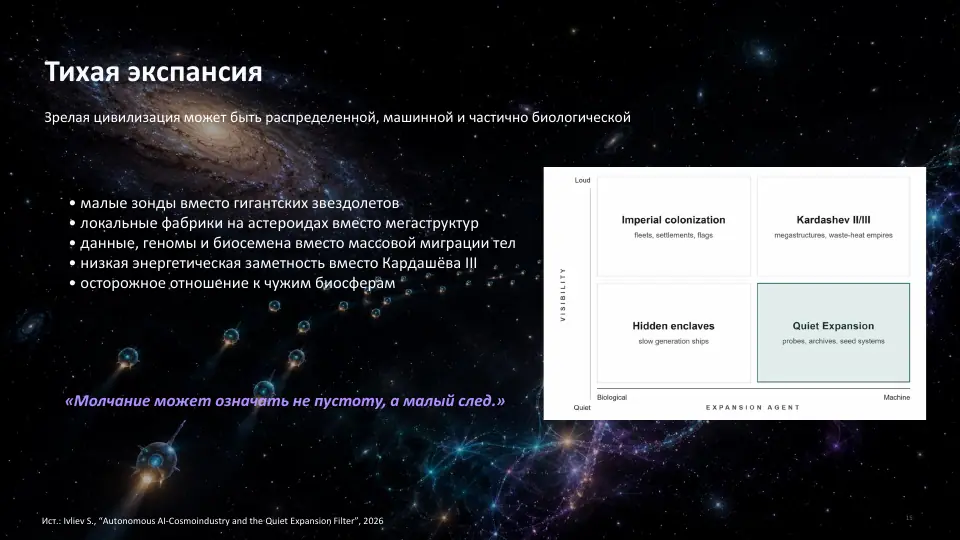
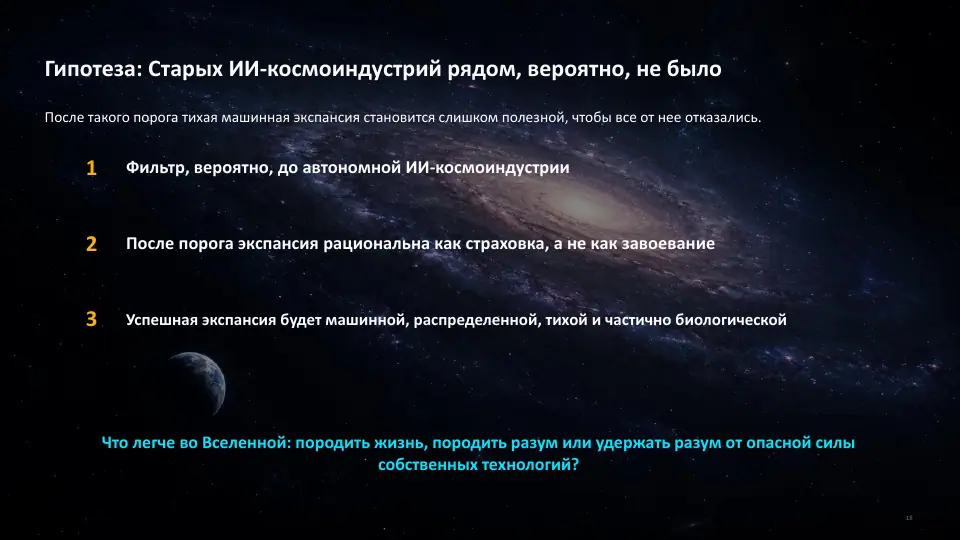
The Fermi paradox in the age of AI
Парадокс Ферми в эпоху ИИ · «А где все?»
A lecture for school students at PASS 2026 on the bank of the Kama at Shemeti, Perm Krai: from the Drake equation and Tipler versus Sagan, through the Great Filter and the RNA world, to Albrecht, Popov and the quiet expansion hypothesis — and what to search for next.
- 18 slides
- in Russian
Cite
Read and cite the paper
@article{ivliev2026quiet,
  title   = {Autonomous AI-Cosmoindustry and the Quiet
             Expansion Filter: A Threshold-Based
             Resolution of the Fermi Paradox},
  author  = {Ivliev, Sergey},
  journal = {arXiv preprint arXiv:2606.13914},
  year    = {2026},
  doi     = {10.48550/arXiv.2606.13914}
}
Ivliev, S. (2026). Autonomous AI-Cosmoindustry and the Quiet Expansion Filter: A Threshold-Based Resolution of the Fermi Paradox. arXiv:2606.13914 [astro-ph.IM]. 28 pages, 1 figure.
Preprint submitted to Acta Astronautica; not yet peer-reviewed. A conceptual hypothesis paper with a narrative review and order-of-magnitude estimates — no new empirical data.